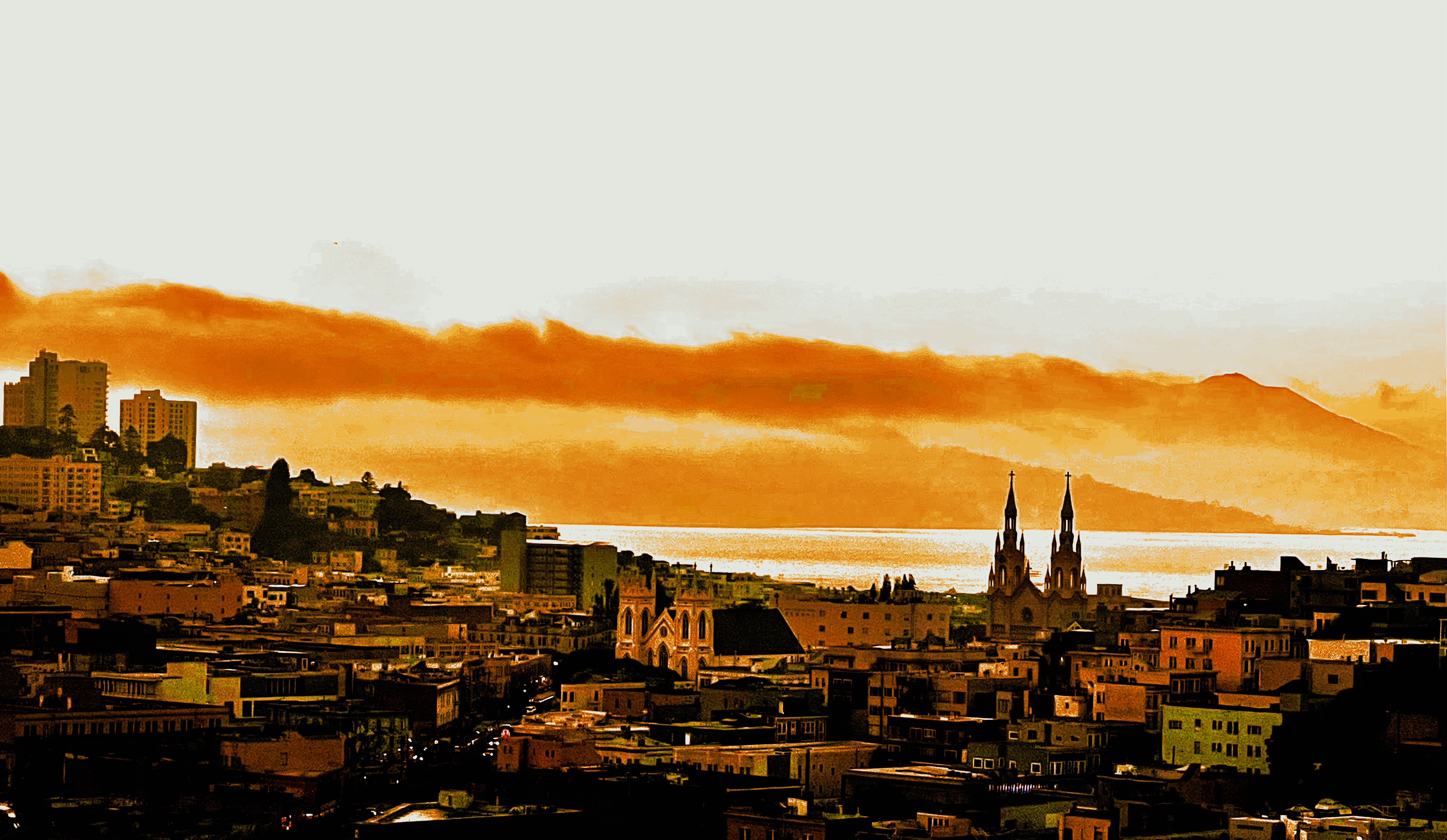
We’re going back to San Francisco in September to celebrate our 39th wedding anniversary, as we’ve done irregularly over the past 41 years or so.

I really love that city. Something about its history, weather, people, culture, and compactness just puts a smile on my face. It feels East Coast, but it’s in California.

I’ve visited a lot of cities in my life, and one thing is clear: you can never really know a city until you live there.

That’s how it is for me when I think about San Francisco.
“Legendary newspaper columnist Herb Caen loved San Francisco so much he gave it a new name. Two of his early books about San Francisco were Baghdad by the Bay (1949) and Baghdad: 1951 (1950). The moniker appeared often in his columns in the 1950s.”
https://openspace.sfmoma.org/2019/06/baghdad-by-the-bay/

No matter how many times I’ve visited in the last 41 years, I’m still a tourist.

Even if I’ve been there twenty or more times since moving to California. The longest I’ve stayed in the city has been a week, and I am usually settled into one of the hotels where you’re bound to find the tourists.

Union Square. Embarcadero. Financial District. SOMA (South of Market). On my first trip, I bravely checked into a motel on the edge of the Tenderloin District. That cost me my hotel-choosing privileges. After that fiasco, only three-star or higher hotels for us.

How bougie of me?
“The first edition of Caen’s post-World War II collection of stories about San Francisco. The collection describes the city as it was then, with its covenants against Chinese living outside of Chinatown, the former soldiers and sailors trying to hold down jobs and find a place to live, and the drinking culture that has been a constant in the city for over 150 years.”
https://www.goodreads.com/book/show/2969519-baghdad-by-the-bay

Call me naive or blinded by rose-colored glasses, but I love the views of San Francisco Bay, the hills, riding BART and the Muni, the cable cars, the Ferry Building, and Lombard Street “On a 27-degree angle, this famously crooked street features eight hairpin turns & landscaped flowerbeds” (Described by Google Maps).

North Beach and Sotto Mare with its great Crab Cioppino, Columbus Avenue and the famous City Lights Bookstore. Chinatown, Mission District (the famously painted Women’s Building), Haight, Richmond District and the Burma Superstar Restaurant, Hayes Valley and our favorite place, Zuni Café.

From the Golden Gate Bridge to Sausalito and north to wine country to the Bay Bridge to Oakland and Berkley, it all seems like a grand voyage through picture-perfect postcard scenes of cultures, class, race, and ethnic havens.

The tall buildings, both commercial and luxury, and the renovated old structures that gleam with newness cannot hide the other San Francisco, where gentrification is more than a slogan for urban removal; it is a reality that affects every residential section of the city.

According to Redfin, “Home prices in San Francisco have increased significantly, with the median sale price reaching approximately $1.7 million to $1.72 million. This represents a year-over-year increase of about 9% to 16% and a staggering surge of roughly $1.01 million since the market low of $625,000 in March 2012 (a 140% overall jump).”

Yeah, that’s a bummer if you’re trying to buy now.

Selling your house? That’s another story

“Prices grew roughly 9.2% to 16.1% compared to last year, driven by a fresh wave of artificial intelligence wealth and tech industry demand in the Bay Area,” according to Redfin.

If you are considering a move there and have the bucks, good news about the crime rate, according to the police: “Crime in San Francisco has fallen to historic lows, with a citywide decrease of nearly 30%. Violent crime dropped by double digits, and homicides reached levels not seen since 1954. Property crimes, including car break-ins, have plummeted to their lowest points in decade.”

Here’s the bad news if you are poor vs. rich: “San Francisco has one of the largest income gaps in the United States, driven by top earners in tech and a high cost of living. The income gap between the top 20% and bottom 20% of the population is nearly 21 times, ranking it second highest among major U.S. cities behind New York City.”

Yes, I know that San Francisco is more than tourist landmarks.

I would love to spend more time in San Francisco to see and learn more about what’s below the city's surface, which gives me a special feeling every time I visit.

We ride public transit as much as possible. It’s a great way to get another perspective on the city and its people. We walk whenever we can in a very walkable city.

We ask the folks who live and work there about places to visit and eat at restaurants where the non-tourists eat.

We’ve been to the Museum of Modern Art and de Young Museum. The Museum of the African Diaspora is on our agenda for our upcoming September trip.

 I have a long list of other places I want to visit. Castro. Ocean Beach (I ran a half-marathon through there once). Sunset District. Spend more time in the Mission District, which is where I ate last time we were in San Francisco.

No matter how often I go to San Francisco, I know that it will be impossible to know and feel what a resident, especially a long-time one, feels and thinks about their city.

They can show you around. Discuss the daily challenges of living in the city. Share the reasons why they stay and, for some, why they want to leave.

It’s never going to be the same as living there yourself for more than a week. When I moved to Southern California, I thought I knew a lot about Los Angeles and the state from watching television shows all those years I lived on the East Coast.

Damn, I was reality smacked when I arrived and discovered a difference between the tourist and resident versions.

I have also learned that if you visit a city enough times, you can almost feel what it's like to be more than a casual visitor.
The city becomes familiar in a way that makes you understand and respect it more, and treat the city and its residents as more than just a tourist destination.

Take the time to see and feel the city below the surface.

Read a local newspaper or media site.

Watch the local TV news. Talk to people.

You might be surprised at how much they want to share with you about the city where they live, work, and love.

Leave a Reply