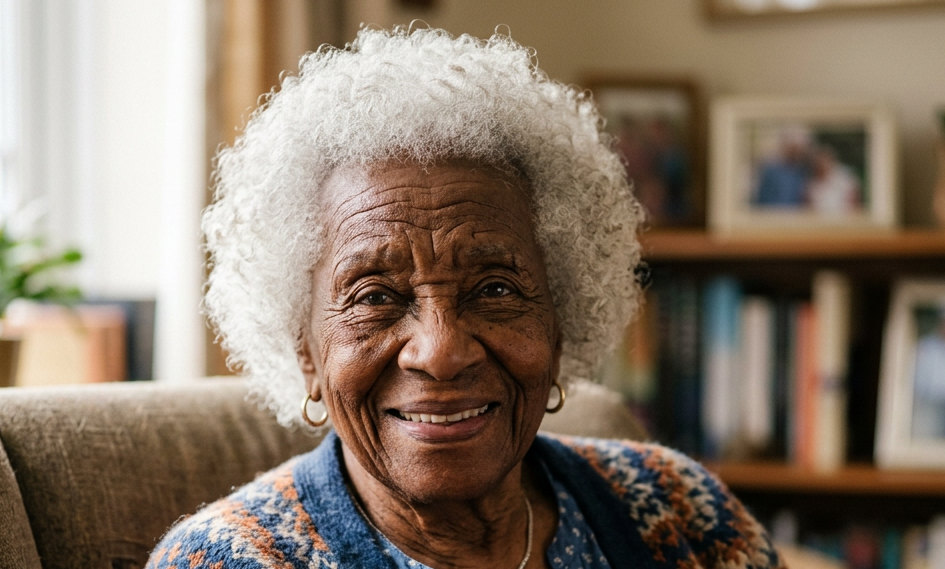
The following is a fictional narrative inspired by a writing prompt in my Playwriting class at California State University, Long Beach (CSULB). We were asked to view several photos, choose one, and write a character description and narrative based on our choice. I chose a picture of an elderly Black woman with features of experience and wisdom.
Momma Julia taught my Dominican mother how to cook grits, really tasty fried chicken, and a whole platter of what we would later realize was called Soul Food.

From a small town called Mule Creek, Mississippi, Momma was very old (I was six when I first met her) and loving. Her white hair sat on her head like a crown. Her husband had been an alcoholic. The stress of life and despair finally killed him. I never met her four children. Momma Julia told me that they all moved away to make their lives.
She lived alone, but she lived every day as if it were the best day of her life.
Momma’s apartment door was always open to the other children and us on the fifth floor at 2595 Third Avenue, South Bronx.
Her face projected a beam of light that engulfed everyone who met her. There was always a smile and a song, humming happy sounds, her hands clasped over her round belly, her drooping breasts invisible under her house dress.
When we moved into the tenement building next door, we were the only Puerto Rican-Dominican family on the fifth floor. Momma adopted my mother the very same day we moved in.

My mother was shy with English-speaking people. She didn’t think her English was good enough, so she insisted I translate for her whenever we went to Hearns or Alexander on Third Avenue.
Now that only English-speaking families surrounded us, she tried to keep us to ourselves. Momma Julia wasn’t having any of it. And while our mother’s English may have been broken-“a little English here, a lot of Spanish there”-Momma told our mother it would be okay.
“I guess I will have to learn a little Spanish.” And she did.
Our father was born in Puerto Rico and worked two jobs at places where people only spoke English; his English was perfect, he always insisted. Pop always wanted us to speak English to our mother and each other.
“This is America, and in America, everyone speaks English.”
Momma Julia could tell that our mother was uncomfortable, so she adopted the whole family (notwithstanding that our father didn’t like that we were the only non-Black family on the floor). Momma was curious about us.
She told our mother that she had never met folks from another country and that her skin color was not far from hers, which led her to say, “I think we have some Africa in common.”

My siblings and I loved some Momma Julia. She would take care of us when Mommy needed to run errands.
I asked her, “How old are you?”
Momma Julia laughed so hard that she scared me.
“I’m as old as the universe and as young as a new day peeking out from behind the sunrise.”
I just stared at her, confused. “How old is that?” I asked.
She laughed some more, got up from the rickety dining room chair, and turned into the kitchen. A few minutes later, she came out with a plate full of peach cobbler in one hand and a glass of milk in the other.
“Sit down, boy, and eat my cobbler, and I’ll tell you about my history and the story of my people.”
I settled down at the Formica table, gobbling up my first peach cobbler, the flaky crust, the peaches drowning in their juices.
I looked up and saw Momma Julia’s eyes close as she hummed a tune I had never heard in our house. She sat back down and began a story about being born after the Civil War and men who hated Black people, the love of her parents, who were born into slavery, and the long journey north to New York to find freedom and peace.

I was only ten, but I knew enough to know that this was not a confession but a lesson—an important lesson for me.
I looked at her as if I was seeing her for the first time, listening intently to her story of a family that was scared of nobody but knew that death was always nearby.
She never stopped smiling, her broken teeth dark and twisted. Over her shoulder, in between bites of cobbler, I could see the picture of Jesus hanging on the wall, but this one differed from the one in our living room.
Everything was the same except that the Jesus on Momma Julia’s wall was Black.
When she would close her eyes during parts of her story, my eyes fell on a row of framed pictures on the shelves of the oak dish cabinet behind her. But there were no dishes.
Instead, there was the photograph of a young woman in a simple wedding dress standing stiffly next to a taller, skinny, handsome Black man dressed in a black suit and white shirt and no tie that hung off his body like an oversized costume.
There were other pictures of what I assumed were her other children playing, of horses and cows in open fields, of a main street with horse-drawn wagons, and of only Black people on the sidewalks.
I figured those pictures were not anywhere in the South Bronx.
I sat there mesmerized by her voice and stories. The peach cobbler was long gone, and the glass of milk was drained. It was only the voice of my mother that broke Momma Julia’s spell.
Mommy stood at the apartment’s door and said it was time for dinner. Momma got up to hug my mother as she always did. My mother kissed her on the cheek and thanked her for looking after me.
I hugged Momma Julia, this time tighter and longer than usual. Somehow, I knew Momma had privileged me with her memorable stories. Stories that would seep into my very soul and into my consciousness, where they remain to this day, giving me comfort and seeing a time as old as the universe and as young as a new day peeking out from behind the sunrise.

Leave a Reply