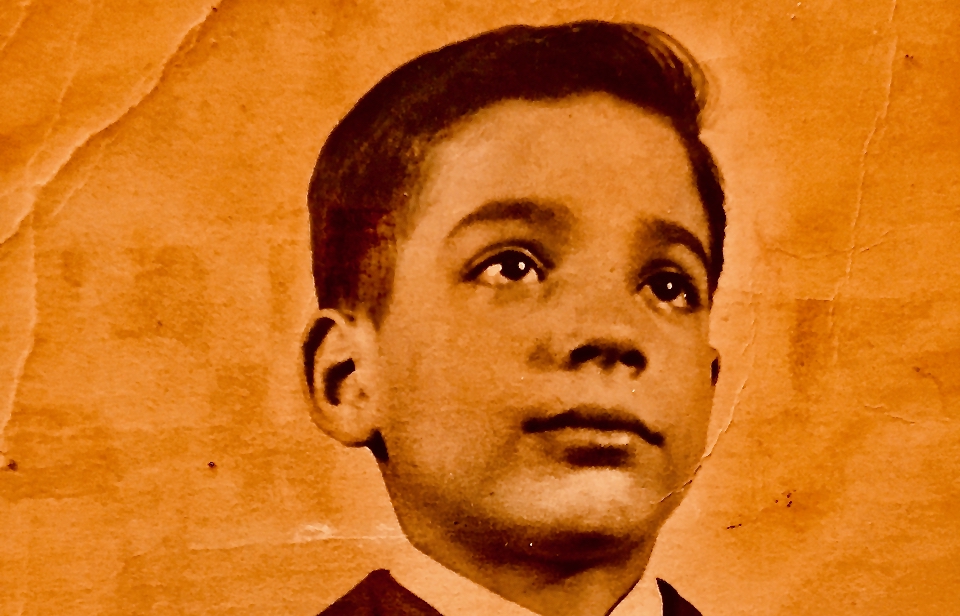
A long read inspired by Jill Talbot‘s “Emergent.”
Something happened to me at the Catholic seminary—seventy miles northwest of the Bronx in Middletown, New York. I changed forever.
Life before the seminary was not idyllic, but it was simple.
1948-1962.
The heartbeat of Spanish filled the air, and the smell of rice, beans, lechon, and pasteles was always in my head.

My immediate world was the Mott Haven neighborhood in the South Bronx, the 149th Street shopping area with Hearns and Alexander’s department stores, and the live poultry market on Westchester Avenue.
I attended St. Rita’s Elementary, a Catholic school with sometimes strict nuns (okay, maybe more often than not). I loved going to church so much that I became an altar boy.
the thought of becoming a priest
		the ritual
		the vestments
		the prayers
		i dreamed it with all my heart
		i was thirteen years old
We lived in public housing, but I never felt poor. I had two parents, sisters, brothers, friends in the building, and at my uncles’ and aunts’ homes with my many cousins that we visited often.
While my father worked two jobs and wasn’t around much, he still found time to drive us to mysterious places nearby and upstate New York (though he never took me to a Yankee game. [Leave it alone. Move on.]). We’d play stickball, box ball, Cowboys and Indians, and all the typical kid stuff like comic books and baseball cards, and did I tell you I never felt poor?

Sure, Renee kicked my ass when I was ten years old, and my parents sent me to Gleason’s Gym to learn how to fight. I sprained my wrist hitting the hanging punching bag on one of my first tries, and I never went back again. But I never got my ass kicked again. I don’t know why. Maybe they felt sorry for me.
i prayed but I wasn’t overly religious
		i think it was more about a spirituality
		seeking something that I felt or saw
		in the sky or clouds from the window
		in the projects
		even then i knew
The seminary was full of young men only: Irish, Italian, Polish, and any other nationality except Black and Puerto Rican. I was the only Puerto Rican-Dominican in my first year there. Someone, I’m sure it was a priest, thought it would be funny to call me Poncho.

It was my first time spending this much time with kids who didn’t look like my friends in the projects.
Throughout the nearly two years there, that was my nickname. I was so naive that I didn’t think much of it. I responded to it. But something told me I better not tell my parents. It was my way of keeping peace. I got along.
I was sleeping in the same dorm and later in the same room, eating with them, studying with them, playing with them, and going to morning mass with them every day. And it was all cool until it wasn’t.
Those were the first two years of high school, ninth and tenth grade. I’m sure kids in those grades went through all kinds of stuff like I did. The bullying, the name-calling, hormones overwhelming you (all I could think about was sex), pimples (lots of pimples), you’re shorter than everyone else (hell, I was on the basketball team called The Midgets).
Yeah, I’ve heard from many people that my first two years of high school weren’t any different from anyone else’s.
It wasn’t like we were enemies or that I was fighting with anyone. It was just that occasionally, someone would shout at me a word that I had never heard before I went to the seminary.
Spic.
What the hell did that mean?
Wait, Spic & Span like in the cleaner?
Then, it would settle down, and they would return to Poncho, and we would all go about our teenage lives. As time went on, something didn’t seem right.
I had been home for Christmas, Easter, and summer, and I started to notice my body changing (damn those hormones). The kids back home were trying their hardest not to curse in front of me, acting like I was a priest already, not feeling like one of them. Not feeling like one of the kids at the seminary.
I can’t swear on a stack of Bibles that I only changed because of the seminary, but I’m sure it played a significant role.
the loneliness of prayer and
	    the silence of retreat
where all that mattered was that i
	    pray to god and the saints and
	    i never questioned the universe
	    even as i looked up at that overwhelming
	    night sky in the middle of nowhere
	    and it was almost like i could touch
	    the planets and the billions
	    of stars looking for heaven and finding
	    my soul whining for something i couldn’t
		name
One morning, I snuck out of the chapel and went to the bathroom to cry and mope that I didn’t want to be there anymore.
The priest came out of the chapel and found me in the recreation room and got angry that I was feeling miserable. I told him I wanted to go home and, without missing a beat, he told me to go home.
That was it.
I was fifteen years old when I left after two years, and the whole world seemed different to me.
I left in April or May of 1964 before the school year finished.
i would look into the eyes of religious statues
		and swear they were speaking to me
		but it was only my imagination
		wishing that something or someone
		would save me would show me a world
		outside my world
		that there had to be
		something more
		there just had to be
Within a couple of hours, I was on a bus from Middletown, New York, to the South Bronx. Done. No good-byes. Banished. But at least I wouldn’t be called Poncho or Spic anymore.
when did i tell myself that the peace
		i wanted was not going to be found in
		that church building or in the chalice or the
		beautiful songs and prayers in latin
				(it was a dead language for a reason)
the emptiness i felt wasn’t there because
		i didn’t find g o d
it was because i
couldn’t find my truth
The seminary expanded my understanding of the possibilities in the world around me.
In rural New York, near a Dairy Farm and away from the projects, I learned that a larger world exists beyond the South Bronx.
Whether it was learning Latin and Caesar’s Gallic Wars, or History, or Math, I became more curious about ideas related to identity, current events, sex, and injustice.
I was angry and depressed.
I never wanted to be called Poncho or Spic ever again.
The summer I left the seminary, I don’t think I left the house for two weeks. My parents had moved to a twenty-one-story public housing project during my second year at the seminary. I didn’t know anyone there. I enrolled in a public high school outside my district, which meant a long bus ride up Westchester Avenue. It was coed, and no one seemed to care who I was.
I was just another kid in a big school from 1964 to 1966, when the world outside started to feel more real to me through the nightly news and the newspapers that my father would leave on the bathroom floor after his two-hour meditation sessions.
It all felt more real to me than ever before. Something inside me developed into a festering blister between fifteen and seventeen. I could feel it. I sensed it. I saw it in the mirror—sad eyes. Pimples on my face that I was convinced came from whatever was hurting inside me.

There was a war in a distant place called Vietnam (I turned 18 in 1966 and was eligible for the draft), Black and White people were being attacked on city streets in the south and in the backwoods, and there was a man named Martin Luther King Jr. who was gaining a lot of attention.
I was pouring all of this into my mind and soul, and I grew increasingly uneasy about what to do with all those feelings and what I was learning.
i changed into someone i didn’t recognize
     for the remainder of my high school years
     i didn’t want to be a priest anymore
     i barely went to church and didn’t mean it
when i did
I found a girlfriend, protested the Vietnam War, and I dreamed of fighting the KKK, Bull Connor, and the horrors I saw on television and in newspapers every day.
I changed, and I realized that something wasn’t clear to me until I graduated from high school. I had grown apart from my parents (I questioned their authority in so many silly ways), tried to find a path for my life, and kept walking blindly, searching for something I thought I would find.
i’m still searching
	will never stop
	and i’m okay with that
		amen.

Leave a Reply